

Epoxy resin fumes are toxic enough to take seriously, and most of what you smell and react to comes from the hardener. Breathing the vapour while you mix and through the first hours of cure irritates the eyes, nose and throat, and repeated exposure can sensitise your airways so that a much smaller dose sets you off later. Once the resin has fully cured it is inert and gives off nothing.
Most of the trouble I see comes from treating the smell as the whole story. The vapour that stings your eyes is only one route into the body, and skin contact with uncured resin is the route that catches hobbyists who never feel a thing while they work. Both routes are manageable in an ordinary garage, and both get worse in a sealed room with the door shut.
What is actually in epoxy fumes
A two-part epoxy kit is a resin and a hardener, and they behave differently in the air. Most hobby resins are built on Bisphenol A, a thick, sticky liquid that on its own is a mild skin irritant. The hardener is the reactive half, and it is usually an amine or a polyamide that carries that faint ammonia or fish smell.
That smell is the part people notice, and it is also the part that does the respiratory damage. Amines are sensitisers, which means repeated exposure teaches your body to overreact to them. The first few sessions may leave you with nothing worse than a headache by evening. The tenth can leave you wheezing from a fraction of the vapour you shrugged off a year earlier.
The smell is a poor gauge of dose. A batch can smell mild and still put enough amine into the air to set off a sensitised person across the room, and a solvent-heavy laminating resin can stink out a whole floor while the amine level stays low. Those solvents behave much like the thinners in a paint or a varnish, and they bring their own headache, dizziness and flammability with them. Read the label for solvent content before you decide how much ventilation is enough.
Uncured resin also sticks to skin in a way soap struggles with. It soaks in over a few minutes and it stays there. That is why the rash often shows up on the backs of the hands and the wrists, and why a pair of gloves does more for you than an open window on its own.
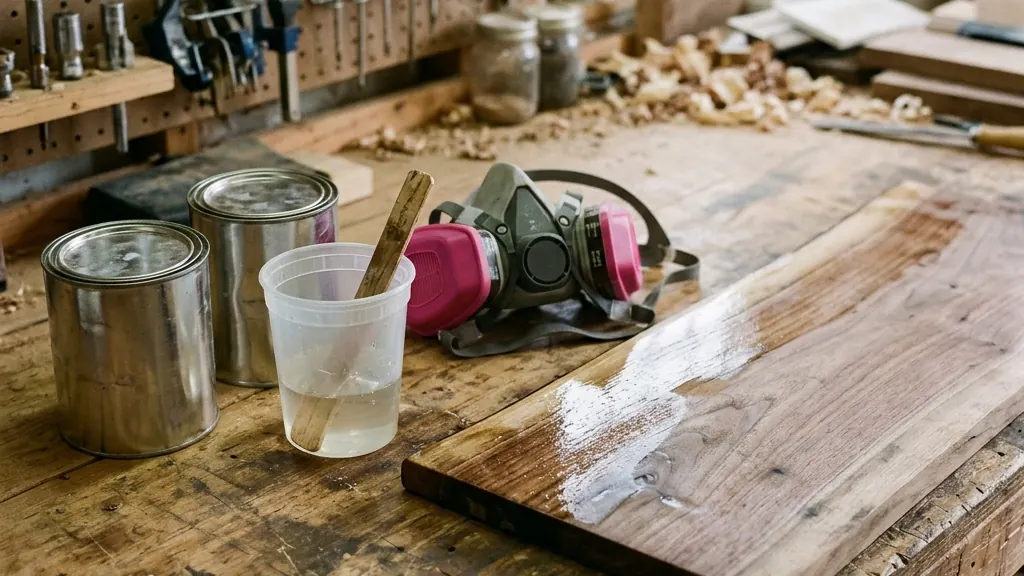
Table of Contents
- What is actually in epoxy fumes
- When the air is worst, and when it stops being a problem
- Symptoms, sensitisation and who should leave the room
- Ventilation, temperature and a workspace that actually works
- Gloves, respirators and what a mask can and cannot do
- Working safely, step by step
- Epoxy Resin Fumes FAQ
When the air is worst, and when it stops being a problem
The vapour load peaks at mixing and stays high through the first hours of cure, while the resin is still liquid and the hardener is still free to evaporate. Once the pour has gelled it drops sharply, and a fully cured piece is inert. That answers the question people ask about dry epoxy. A hardened coaster or a finished tabletop gives off nothing you can breathe.
Temperature controls how long that window stays open. Epoxy cures on a chemical reaction, and the reaction slows in the cold. A garage in January might keep a pour tacky for a day or more, and every one of those hours is an hour of vapour. The same pour in July sets quickly and closes the window early, though a thick batch in a hot room can run away on you.
Runaway is the one genuinely alarming event in this work. A deep pour generates its own heat, and if that heat cannot escape the batch can scorch, crack and smoke. A smoking cup is a real emergency. Carry it outside, set it on concrete away from anything flammable, and let it finish reacting in the open air.
Sanding is a separate job with a separate hazard. Cured epoxy makes a fine dust, and that dust is a particulate problem, so a dust mask and goggles come out for sanding even though they were useless against the vapour. Wipe the surface with warm water afterwards to lift the waxy film that amine hardeners leave behind, or the next coat will not bond.
The cured state is also what makes a finished piece safe to use. If you are wondering whether a poured board is safe to chop on once it has hardened, the answer lives in the cure and the finish, and the details of whether epoxy resin cutting boards are safe are worth checking before you put a knife to one. Pieces that take direct heat are a different question again, and if you are casting an ashtray the cured resin has to cope with a lit cigarette as well as the pour, which is why it pays to read up on whether epoxy resin ashtrays are safe before you start.
Symptoms, sensitisation and who should leave the room
Short-term exposure in a closed room shows up fast. Expect headache, dizziness, nausea, stinging eyes and a dry throat, and if the vapour is heavy enough you will cough and feel tight across the chest. Those symptoms ease when you get into fresh air, which is exactly why people ignore them and go back in.
The delayed reaction is the one that matters. Epoxy sensitisation builds silently, and it does not usually reverse. Someone who has been pouring resin in a spare bedroom for a year can reach a point where a two-minute mix sets off a rash or an asthma-like attack. From then on the same person reacts to lower and lower levels, and the only reliable fix is to stop breathing the stuff entirely.
Some people should not be in the room at all while a batch is open. Anyone with asthma or another chronic lung condition, anyone pregnant, and small children are the obvious group, and a hobbyist who already reacts to resin should treat the workshop as off limits during a pour. If a cough or a wheeze does not settle within a few hours of leaving the space, get it looked at.
Skin reactions follow the same pattern. A red, itchy patch on the fingers, the backs of the hands or the eyelids is the classic epoxy rash, and it often appears where a contaminated glove touched skin instead of where the resin was spilled. Blistering means you are past the irritation stage. Stop, wash with soap and warm water, and do not go back in until it has healed.
Dogs and cats belong outside the work area for the whole cure. They are closer to the floor, where the heavier part of the vapour sits, and a smaller body reaches a meaningful dose faster. A dog that has been in the room may cough, sneeze, develop a runny nose or just go quiet and sleepy for a day. If that does not clear once the animal is out of the space and in fresh air, ring your vet.
There is a wider version of this question that comes up constantly in the workshop, and it is covered properly in this piece on whether epoxy resin fumes are dangerous for people who work with them every week.
Ventilation, temperature and a workspace that actually works
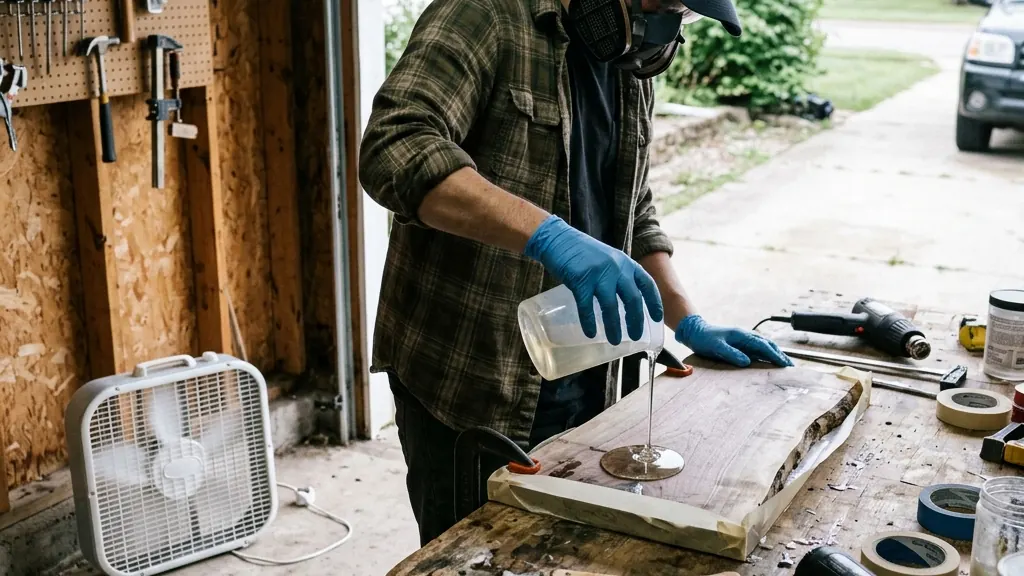
Ventilation is about direction. You want clean air entering behind you and moving across the work and out, so the vapour leaves the room without crossing your face on the way. A window on one side and a fan in the opposite opening, pushing outward, beats an open door and a still room every time.
A fan aimed at your face is worse than no fan at all. It stirs the vapour off the tray and pushes it straight into your breathing zone. Put the fan behind you and low, and let it move air past the work instead of at it.
Basements are the hard case. They rarely have a cross-draught, and a furnace or a water heater with a pilot light often sits in the same space. Work in a garage if you have the choice. If the basement is the only option, run the fan out of a window for the whole session and keep the door to the house shut with a towel along the gap.
Garages bring the temperature problem. In January the resin is thick, the hardener is slow and the vapour lingers for hours, so warm the space before you mix and give the batch somewhere warm to sit while it gels. Come July the same garage can be too hot, with a short pot life and a thick pour that heads toward runaway, so work early in the morning and keep the batch shallow. A cold snap in February is the worst of both, cold enough to stall the cure and still closed up tight against the weather.
Cover the bench before anything comes out of the tin. A sheet of PVC sheeting or a Silicone mat catches the drips and peels clean afterwards, and an offcut of EPDM membrane makes a tough, non-slip surface under a heavy mould. Tape the edges down. A drip that reaches a wooden bench top is a drip you will be sanding out next weekend.
Keep the curing piece out of the house. A spare bedroom, a kitchen counter or a utility room with the door shut will hold the vapour in exactly the way you do not want. A shed or a garage with the door cracked is a better home for a pour, even in a cold month.
Gloves, respirators and what a mask can and cannot do
Nitrile gloves are the standard for epoxy work, and they need changing more often than most people change them. Latex and vinyl both let the resin through in a short time, and a glove that has been in contact with mixed resin for an hour is a glove you should bin. Peel it off by the cuff so the contaminated outside never touches your wrist.
Gloves alone leave the forearms and the eyes exposed. A long-sleeved shirt or a disposable apron covers the arm, and goggles cover the eyes where safety glasses leave a gap at the side, because a splash of hardener in the eye is a hospital trip. The vapour also irritates eyes directly, and goggles cut that down as well.
The respirator is where the confusion lives. A half-face respirator with organic vapour cartridges is the right tool for mixing and pouring indoors. A paper dust mask does nothing against vapour, and wearing one while you mix gives you false confidence about what you have filtered out.
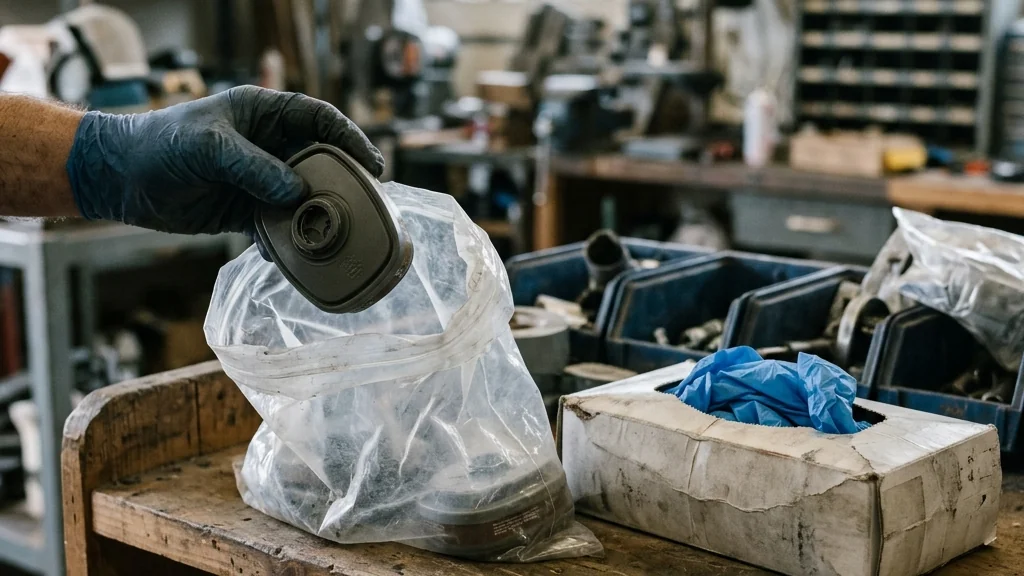
Fit matters as much as the cartridge. The mask has to seal against clean, shaved skin, and you check it by covering the cartridges with your palms and breathing in gently. If you feel air creeping in around the edges, the seal is wrong and the cartridges are working on a fraction of your air. Store them in a sealed bag between sessions and replace them when you can smell the resin through them.
None of this equipment supplies oxygen. A respirator in a sealed room just filters what is already there, so the window stays open and the fan stays on. If the air in the room makes your eyes water before you have opened the tin, it is not a room to mix resin in.
Working safely, step by step
Set-up takes longer than the pour, and it is the part that keeps you out of trouble.
- Read the label before the tin is open. Note the mix ratio, the pot life and the cure time, and check what the maker says about ventilation and flammability.
- Clear the space. Pets out, children out, food and drink out, and the bench covered with PVC sheeting or a Silicone mat taped down at the edges.
- Set the airflow first. Open a window behind you, put a fan in another opening pushing out, and shut the door that leads into the house.
- Dress for it. Nitrile gloves, long sleeves, goggles and a fitted respirator with organic vapour cartridges, checked for a seal before you start.
- Mix low and slow in one spot. A steady stir keeps the vapour down and pulls less air into the batch than a fast whisk.
- Pour, spread and leave. Get out of the room for the first hours of cure with the fan running, and come back when the smell has dropped.
- Clean up before the gloves come off. Wipe tools with Acetone outdoors or with warm soapy water, and bag the rags and take them outside.
- Sand only after a full cure, with a dust mask and goggles, and wipe the amine blush off with warm water before the next coat goes on.
Stop the job if the batch starts to smoke, if the room fills faster than the fan can clear it, or if you feel tightness in your chest while you are still working. A smoking cup goes outside onto concrete, and a chest that tightens is your cue to leave and stay out for the rest of the day. For a large floor coating, a boat hull or anything that has to be poured in a confined space, a contractor with supplied air and extraction is the right call, and that cost belongs in the estimate from the start.
Epoxy Resin Fumes FAQ
Are epoxy resin fumes toxic to breathe?
Breathing uncured epoxy vapour irritates the eyes, nose and throat and can bring on coughing and chest tightness in a closed room. The hardener causes most of that reaction, and the risk climbs with every repeat exposure.
How long does epoxy give off fumes?
The strongest vapour comes off while you mix and during the first hours of cure, and it falls away as the resin gels and hardens. A cold room stretches that window out, so a warm workspace shortens your exposure.
Is epoxy resin toxic once it is dry?
Fully cured epoxy is inert and does not release fumes, so a hardened piece is safe to handle and keep indoors. Sanding it later creates dust, which is a separate hazard that needs a dust mask and ventilation.
Should you wear a mask while using resin?
A half-face respirator with organic vapour cartridges is the right protection for indoor epoxy work, and a plain dust mask will not stop the vapour. Fit matters as much as the cartridge, so check the seal before you start.
Are epoxy fumes dangerous to dogs?
Dogs should be kept out of the room while epoxy cures because they are close to the floor where the heavier vapour sits and their smaller bodies reach a dose faster. Watch for coughing, a runny nose or lethargy afterwards, and ring your vet if it does not settle.

Martin Flood
Martin Flood has been working in the construction industry for over 20 years as a general contractor with expertise in remodeling projects that are large or small. He has furthered his career by specializing in epoxy resin flooring, providing excellent service to both commercial and residential clients. Martin’s experience enables him to offer professional advice on how to choose the right type of project based on your needs and budget.
View all posts by Martin Flood →
4 thoughts on “are epoxy resin fumes toxic?”