
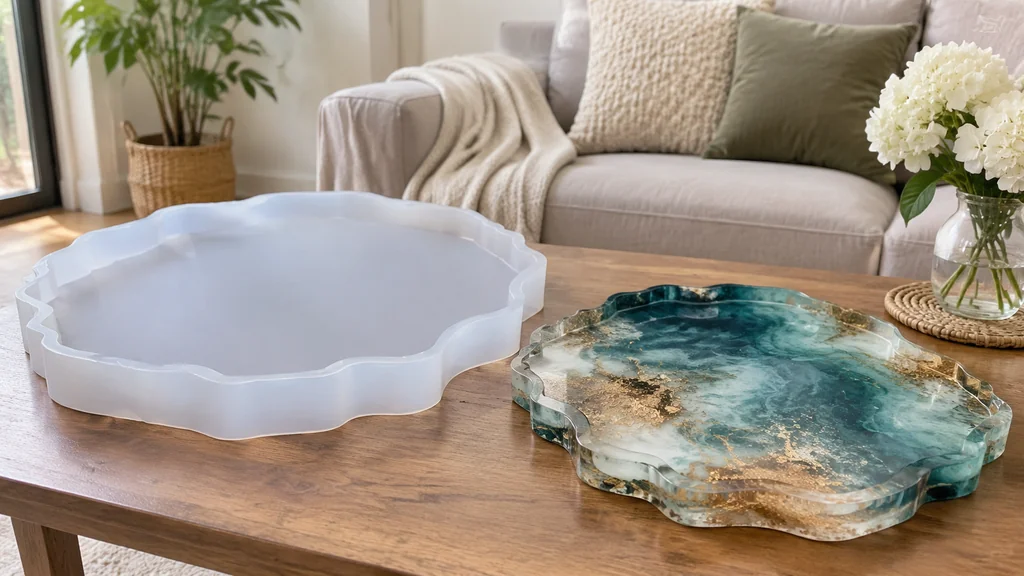
Large silicone molds let you cast resin in one piece, and the mold itself decides whether that works. Pick a mold with walls thick enough to hold their shape, a silicone soft enough to release a deep casting, and a resin poured in layers thin enough to cure without cooking. Get those three right and a big pour is calm work.
What Makes a Silicone Mold “Large” Enough for a Big Pour
Size alone tells you very little. A mold is large in the practical sense when its walls can resist the weight of filled resin without bowing outward, and when the cavity is deep enough that the resin has somewhere to go besides the surface.
Silicone rubber is available in hardness levels between 10 and 100 on the Shore A or IRHD scale, giving you a broad range of grades to choose from, from a floppy casting rubber to a firm gasket material. A very soft silicone in a big open mold will sag at the rim once you fill it. A firm one holds its shape but fights you at demolding. For large resin molds, most casters land somewhere in the middle and accept a little more release effort in exchange for a mold that stays put.
Wall thickness matters as much as the shore number. Thin walls on a wide cavity bulge under the hydrostatic load of liquid resin, and a bulged wall cures into a casting with a belly in it. Feel the rim of a mold before you buy. If it folds over under light finger pressure across a wide span, it will not hold a full pour.
The other thing to check is how the mold was made. A mold cast around a solid master with a proper outer shell behaves very differently from a thin skin supported by nothing. If you are building your own mold, the two DIY methods for making a silicone mold for resin both reward a generous wall and a rigid mother mold around the outside.
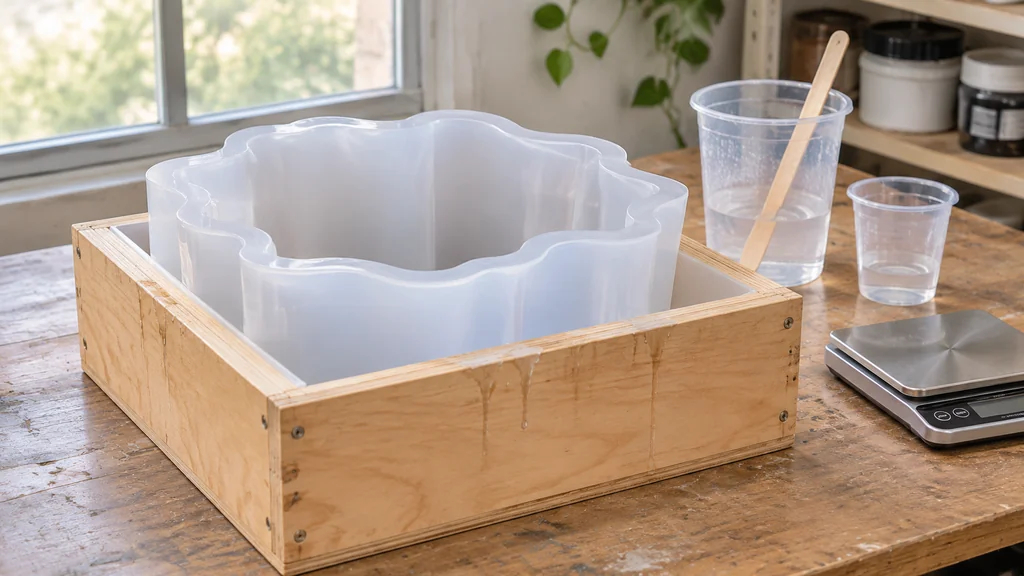
Table of Contents
- What Makes a Silicone Mold “Large” Enough for a Big Pour
- Choosing Extra Large Silicone Molds for Resin: What to Look At
- Setting Up the Workspace Before You Pour
- The Pour, Step by Step
- Avoiding the Mistakes That Ruin Big Castings
- When to Buy a Bigger Mold and When to Build One
- Caring for Large Molds So They Last
- Large Silicone Molds for Resin FAQ
Choosing Extra Large Silicone Molds for Resin: What to Look At
When you are shopping for extra large silicone molds for resin, the listing photos rarely tell you what you need. Work through these points instead.
- Cavity depth against wall height. A deep cavity with a shallow rim gives you nothing to grip when you demold. The rim should stand proud of the resin line.
- Corner radius. Sharp internal corners trap air and tear on release. Rounded corners release cleanly and survive repeated use.
- Surface finish inside. A glossy interior gives a glossy casting face. A matte interior hides fine scratches better but shows every bubble.
- Whether a support shell is included. Check the product listing to see whether the mold includes a rigid tray or cradle. Without one, you supply your own.
- Material honesty. Ask what the silicone is. Platinum-cure silicone is the usual choice for mold making because it does not inhibit cure the way some tin-cure rubbers can.
Temperature tolerance is worth a thought if you plan to warm the mold or work in a cold shop. Check the mold manufacturer’s stated service-temperature range for your application. Your resin is the limiting factor, so check the label on the resin you buy.
If you are weighing a homemade mold against a bought one, remember that a large mold is a big investment in silicone. Making your own lets you size the cavity to match the pour.
Setting Up the Workspace Before You Pour
A big pour fails at the bench far more often than it fails in the mold. Set the room up first.
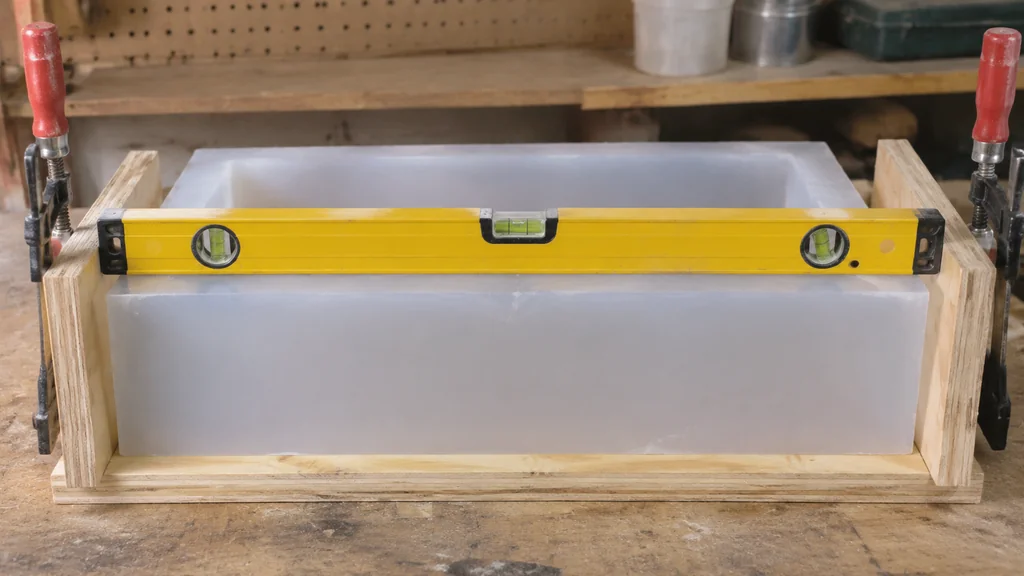
Level the mold. A large silicone mold on an uneven bench cures with a wedge-shaped top, and you cannot sand that away without losing the surface. Use a spirit level across the rim in two directions. A shallow tray of sand under the mold lets you bed it level.
Control the temperature of the room and the resin. Cool resin holds air and pours thick. Warm resin kicks fast and can trap bubbles before they rise. Most casters aim for a comfortable working room and let the resin sit in it long enough to reach room temperature.
Have your release plan ready before the resin goes in. Some silicone molds need no release agent, some do after a few casts, and some resins bond to silicone more than you expect. Test a small pour in a corner of the mold if the mold is new to you.
Line the bench. A large mold is heavy when full, and a spill at that volume is a serious cleanup. A plastic sheet under the whole setup costs little.
Read the resin data sheet before the first big pour. Keep it beside the workspace during the pour.
The Pour, Step by Step
This is the sequence I use for a large mold. It is slow on purpose.
- Seal and prepare the mold. Clean the cavity, check for dust, and apply release only if your resin and silicone combination calls for it.
- Mix in small batches. Large single batches of resin generate heat fast. Mix what you can pour within the working time and keep the rest unmixed.
- Pour down the side. Tip the cup against the mold wall and let the resin run down rather than dropping it into the middle. This drags fewer bubbles into the depth.
- Pour in layers for deep cavities. Let each layer gel before the next. A deep single pour can exotherm hard enough to crack or discolour. The guide to clear casting resin for deep molds covers how layer depth and cure heat interact.
- Remove surface bubbles. Pass a heat gun quickly across the surface, keeping it moving so one spot does not overheat.
- Let it cure undisturbed. Vibration, draughts and a cold floor all show up in the finished face. Give it the full cure time on the label before you touch it.
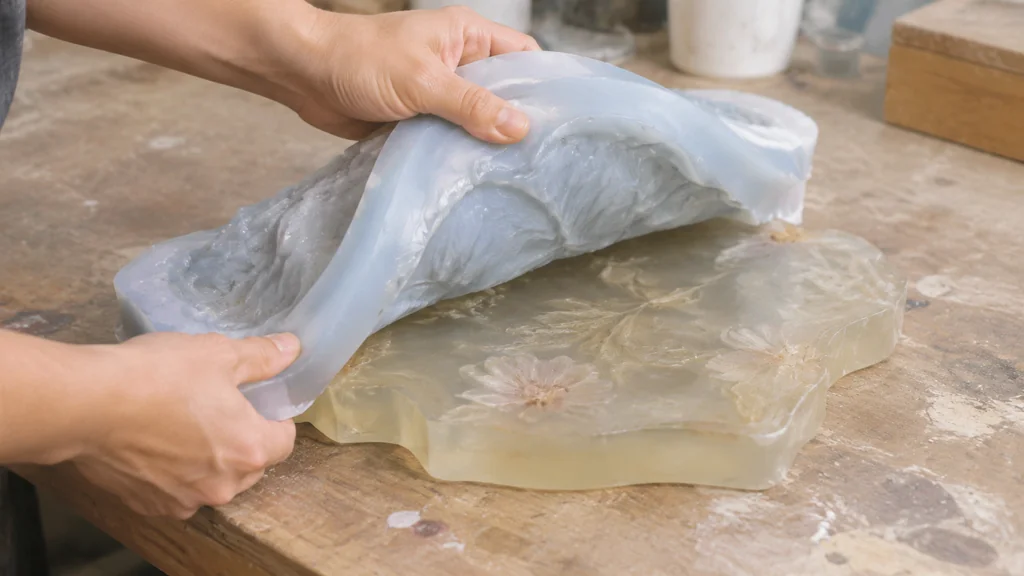
- Demold slowly. Roll the silicone away from the casting rather than pulling the casting out. Work around the perimeter first, then lift.
The demolding step is where large molds get damaged. Silicone tears at a thin edge under a hard pull, and a tear grows with every subsequent cast. Patience here extends the life of the mold more than anything else you do.
Avoiding the Mistakes That Ruin Big Castings
The failures on large pours cluster around a few causes.
Too much resin at once. A deep single pour heats up in the middle, and that heat distorts the casting and can scorch the colour. Layers solve it.
A mold that was never supported. Silicone is flexible by design. A wide cavity needs a rigid cradle, a box, or a shell to hold its shape. Skipping this is the most common cause of a casting with bowed sides.
Pouring cold. Cold resin is viscous and holds air. Let the resin and the room come to temperature.
Demolding early. Resin that feels hard on the surface can still be soft inside a thick section. Follow the cure time on the label and add a little for a cold workshop.
Using the wrong mold entirely. Baking molds and resin are a combination worth understanding before you try it, because not every flexible mold is silicone and not every silicone is happy with resin solvents.
Skipping the test cast. A small test pour in a corner tells you about release, bubble behaviour and cure time for a fraction of the resin. Do it once per new mold and resin pairing.
When to Buy a Bigger Mold and When to Build One
Buying makes sense when the shape is standard and the size is modest. Building makes sense when the cavity has to match a specific object, when you need a wall thickness you cannot find off the shelf, or when you plan to cast the same piece many times and want a mold you understand inside out.
A bought extra large mold arrives with someone else’s decisions baked in. You get the shore hardness, the wall, the finish and the corner radii they chose. That is fine for a planter or a tray. For a one-off casting that has to fit something, building gives you control.
The cost balance shifts with size. Silicone is sold by weight, and a large block mold uses a lot of it. A thin skin mold with a rigid mother mold uses far less silicone and performs well for simple shapes. That trade is worth doing on paper before you order material.
Caring for Large Molds So They Last
Store big molds flat or supported, never folded. A crease that sits for months becomes a permanent line in every casting.
Keep them out of direct sun and away from sharp tools on the bench. Silicone cuts easily and a nick at the rim becomes a tear.
Clean with a soft cloth and mild soap, and avoid solvents that swell the rubber. Let the mold dry fully before the next pour.
Retire a mold when the surface starts to show a texture or when tears reach the cavity. A worn mold makes worn castings, and no amount of finishing fixes a mold that has given up.
Large Silicone Molds for Resin FAQ
How deep can I pour resin into a large silicone mold in one go?
It depends on the resin, and the label is the authority. Deep single pours generate more cure heat in the centre than thin ones, and that heat is what causes cracking and colour shift. Most casters pour in layers for anything deep and let each layer gel before adding the next.
Does a bigger mold need a firmer silicone?
A wide cavity benefits from a firmer silicone or from a rigid support around a softer one. Silicone rubber is available in hardness levels between 10 and 100 on the Shore A or IRHD scale, giving you a broad range of grades to choose from. Match the grade to the cavity width and to how much you are willing to work at demolding.
Can I use a large silicone mold in a cold garage?
Cold resin pours thick and holds air. Bring the resin and the room up to a sensible working temperature first, and check the specific mold’s temperature rating before use.
Why does my large casting come out with bowed sides?
The mold wall moved while the resin was liquid. A wide silicone cavity bulges under the weight of a full pour unless it sits in a rigid cradle, box or shell. Support the mold before you fill it and the sides stay where you put them.
How many casts will a large silicone mold survive?
It depends on the silicone grade, the resin, the release routine and how carefully you demold. Roll the silicone away from the casting rather than dragging the casting out, store the mold flat, and avoid sharp tools near the cavity. A mold treated that way lasts far longer than one pulled hard at the rim every time.

Martin Flood
Martin Flood has been working in the construction industry for over 20 years as a general contractor with expertise in remodeling projects that are large or small. He has furthered his career by specializing in epoxy resin flooring, providing excellent service to both commercial and residential clients. Martin’s experience enables him to offer professional advice on how to choose the right type of project based on your needs and budget.
View all posts by Martin Flood →