
Updated June 2026
Sanding epoxy resin requires wet sanding through progressively finer grits — starting at 220 or 320 for general leveling, finishing at 1500–2000 — followed by a polishing compound to restore full clarity. The biggest mistake most people make is starting too coarse without a reason, or skipping grits. Polishing compound cannot save scratches left by 400-grit paper if you never ran 600, 800, and 1000 first.
I learned this the hard way on my first river table. Sanded the whole top at 220, felt smooth to the touch, went straight for the polish. The result looked great under dim workshop lights. In daylight, it was a mess of fine scratches you could see from three feet away. I had to start over at 400. This guide is what I wish I had read first.
What You Need Before You Start
You do not need expensive equipment to get a glass-clear finish. What matters is having the right grits in sequence and the patience to use them properly.
Sandpaper: Get wet/dry sandpaper specifically — ordinary woodworking sandpaper will disintegrate when wet and scratch unevenly. Mirka is the brand I use most often; their Waterproof series holds up well. You want: 120, 220, 320, 400, 600, 800, 1000, 1500, 2000. Buy extras of 400 and 600 — those are where you spend the most time.
Sanding block: A rubber sanding block keeps pressure even across flat surfaces. Without one, finger pressure concentrates on small spots and creates low/high areas. For curved pieces, a folded sheet works better.
Water spray bottle: Standard plant mister. Keep it full. You are adding water constantly when wet sanding.
Polishing compound: 3M Finesse-It II is what most resin workers use for final clarity. Meguiar’s Ultimate Compound works just as well and is easier to find at auto parts stores. Do not use toothpaste — it works in a pinch on tiny scratches, not for finishing a whole surface.
Buffing pad: A foam polishing pad for a drill or orbital makes polishing much faster. You can hand-polish with a microfiber cloth and it still works, just takes longer.
Safety: N95 mask minimum for any dry sanding steps. Epoxy dust is not something you want in your lungs. Safety glasses. Wet sanding reduces airborne dust dramatically — one of several reasons to prefer it.
Table of Contents
- What You Need Before You Start
- Wet Sanding vs. Dry Sanding: Which Should You Use for Epoxy?
- The Grit Progression Guide: Every Step Explained
- Step-by-Step: How to Sand Epoxy Resin Smooth and Clear
- Common Mistakes That Leave Epoxy Cloudy or Scratched
- Restoring Clarity After Sanding: The Polishing Phase in Detail
- Safety: Epoxy Dust Is Not Trivial
- Frequently Asked Questions
- The Short Version
Wet Sanding vs. Dry Sanding: Which Should You Use for Epoxy?
Wet sanding is better for epoxy resin in almost every situation. Here is why it matters:
| Factor | Wet Sanding | Dry Sanding |
|---|---|---|
| Heat buildup | Minimal — water cools the surface | High — epoxy can soften and gum up |
| Dust | Contained in water slurry | Airborne — respiratory hazard |
| Sandpaper life | Paper lasts 3–4× longer | Clogs fast with epoxy resin |
| Scratch pattern | Finer, more consistent | Can be uneven at fine grits |
| Best for | Mid-grits through 2000, final stages | Knocking down drips at 80–120 grit |
The rule I follow: dry only for the initial rough pass (80–120 grit) when I need to remove a drip or level a hard edge. Everything from 220 onward is wet. Epoxy generates heat when sanded dry — enough heat to partially soften the surface and leave smearing instead of clean cuts.
The Grit Progression Guide: Every Step Explained
This is the most important section. Each grit level removes the scratches left by the one before it. Skip a step and the next grit cannot catch up.
| Grit | Purpose | Wet or Dry | Approximate Time (per sq ft) |
|---|---|---|---|
| 80–120 | Remove drips, bubbles, sharp edges, heavy imperfections | Dry | 3–8 min (only if needed) |
| 220–320 | General leveling, remove tool marks from coarser grits | Wet | 5–10 min |
| 400–600 | Smoothing — surface starts to look hazy but even | Wet | 5–8 min per grit |
| 800–1000 | Pre-polish — deep scratches are gone, fine haze remains | Wet | 4–6 min per grit |
| 1500–2000 | Near-clarity — surface looks like frosted glass | Wet | 3–5 min per grit |
| Polish (3000–5000 equivalent) | Full clarity — removes remaining micro-scratches | Compound + pad | 5–10 min (by hand or drill) |
A note on the 80-grit step: only use it if you genuinely need to remove something — a large drip, a sharp ridge from an overflow edge, a deep bubble crater. If your surface just needs general smoothing from a slightly textured pour, start at 220. Going coarser than necessary just creates more scratch depth to work back up from.
Step-by-Step: How to Sand Epoxy Resin Smooth and Clear
Step 1: Confirm Full Cure — This Is Non-Negotiable
Minimum 72 hours after your final pour, ideally 7 days. I know it feels ready after 24 hours. It is not. Press a fingernail firmly into an inconspicuous edge or the underside. No mark at all? You are good. Any dent or soft feeling? Wait another day and test again.
High-ambient-temperature pours cure faster. Pours in cold workshops (under 65°F / 18°C) can take well past 7 days to reach full hardness. Thick pours — anything over half an inch — also take longer in the core than at the surface.
Step 2: Knock Down Major Imperfections (80–120 Grit, Dry)
Only do this step if you have drips, prominent bubbles that popped and left craters, or a pour line from an edge tape. Use 120 grit on a sanding block, work in straight passes with the grain of any underlying wood, and check your progress every 60 seconds. You are removing material — it is easy to go too deep and create a low spot.
Wear your N95 here. Dry epoxy dust is fine and gets airborne immediately.
Step 3: General Leveling (220–320 Grit, Wet)
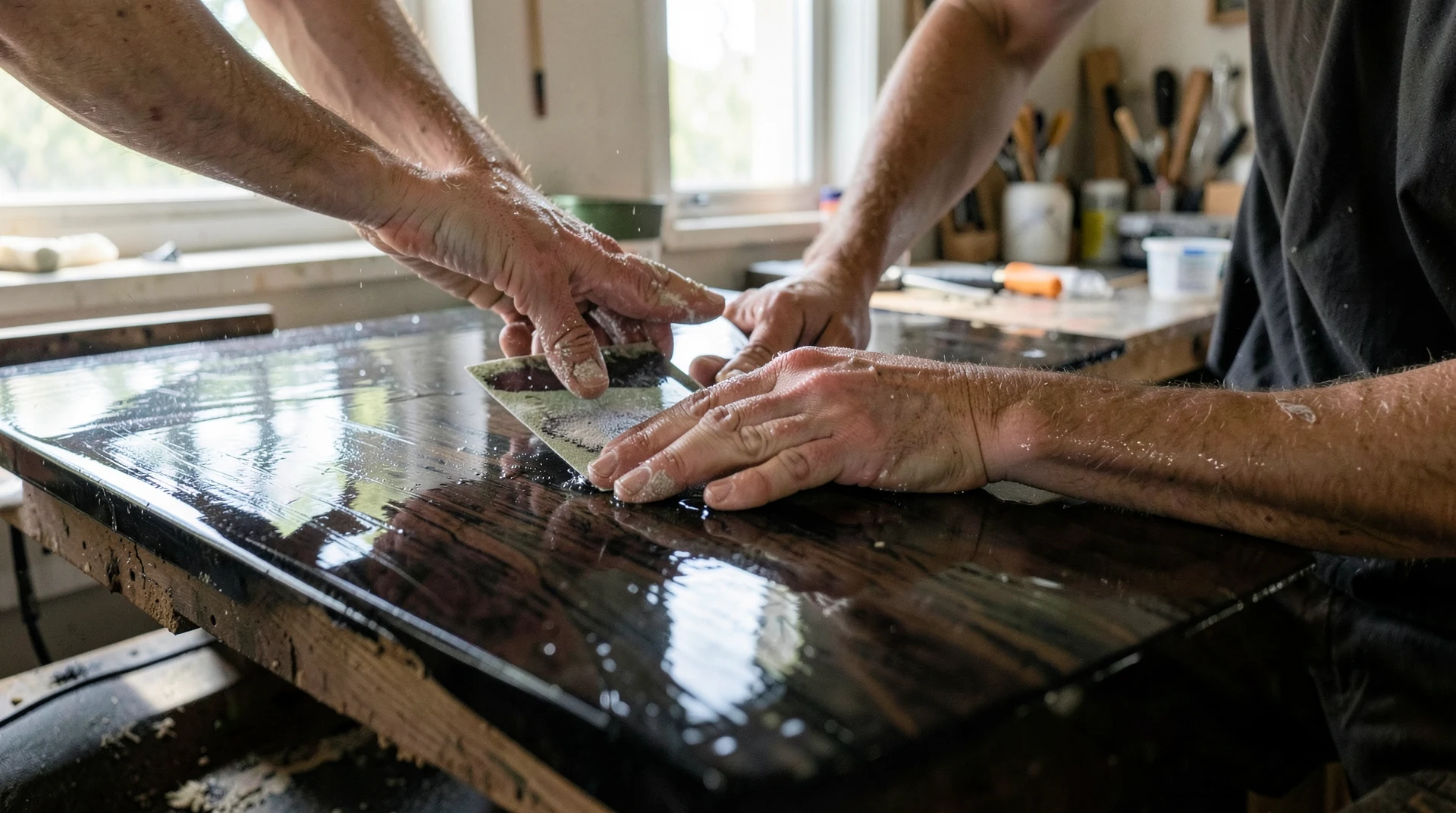
Fill your spray bottle. Wet the surface, load your 220-grit sheet onto the sanding block, and begin long overlapping passes. Keep the surface wet at all times — you will see a milky white slurry building up. That slurry is doing the work. Rinse every 2–3 minutes, dry the surface briefly, and inspect under a raking light (hold a work light low and angled across the surface). You are looking for consistent scratch pattern with no shiny patches. Shiny patches mean the paper has not touched there yet.
Move to 320 when 220 has left a completely even matte surface.
Step 4: Mid-Grit Smoothing (400–600 Grit, Wet)
Same technique. The surface starts looking more like frosted glass than matte at this stage. At 600 you should have no visible deep scratches under good light — just fine, uniform haze.
Rinse thoroughly between each grit change. A single grain of 400 grit contaminating your 600-grit paper will leave a scratch line across the whole surface. I keep separate water bowls for rinsing my hands between grits.
Step 5: Pre-Polish (800–1500 Grit, Wet)
By 1000 grit, the surface should look close to clear in indirect light but still hazy head-on. By 1500, you are almost there. Work slowly — the benefit of pressure becomes marginal at these fine grits. Let the abrasive do the work without forcing it.
Step 6: Final Sanding (2000 Grit, Wet)
Light pressure, plenty of water. When you rinse and hold the piece up to light, it should look like polished frosted glass. Completely uniform micro-haze across the whole surface. Dry it completely with a clean cloth before moving to polish.
Step 7: Polishing Compound to Restore Full Clarity
Apply a small amount of polishing compound — about the size of a quarter — to a foam pad or folded microfiber. Work in overlapping circles over a 6-inch section. You will see the haze transform to a glossy shine almost immediately as the compound fills and levels the remaining micro-scratches.
Move to the next section before the compound dries white. Buff off with a clean microfiber.
Repeat until the entire surface is clear. If one pass does not give you the clarity you want, do a second pass with fresh compound. A machine polisher at 1200–1800 RPM will get you there faster and with less arm fatigue than hand polishing a large table.
For a look at how to build on this finish toward a truly glass-like coating, our guide on how to make epoxy resin look like glass covers the next steps including UV-resistant topcoats.
Common Mistakes That Leave Epoxy Cloudy or Scratched
Sanding too early. Already covered, but worth repeating — this is the most common mistake. Soft epoxy clogs paper, creates sticky ridges, and produces uneven surfaces that require a full re-sand or even a fresh pour.
Starting too coarse with no good reason. If your surface came out of the mold reasonably smooth, starting at 80 or 120 just creates extra work. Assess what you actually have, then pick the coarsest grit you need — not the coarsest grit available.
Skipping grits. 400 to 1000 seems like a reasonable jump. It is not. The 400-grit scratches are too deep for 1000 to remove efficiently — you will polish and polish and still see a haze that will not clear. Go 400 → 600 → 800 → 1000. No shortcuts.
Too much pressure at fine grits. Above 800 grit, heavy pressure does not cut faster — it just creates heat and uneven scratch patterns. Light, consistent passes are better.
Using dry sandpaper for the full process. Without water to cool the surface, epoxy heats up quickly. Heated epoxy softens slightly, which creates gummy buildup on the paper and can cause surface deformation on thinner pieces. Wet sand everything from 220 onward.
Skipping the polish step. 2000-grit finish without polishing looks foggy. Polishing compound is mandatory if you want a clear, glossy result. It is not optional.
Restoring Clarity After Sanding: The Polishing Phase in Detail
Once you hit 2000 grit, the surface is ready for compound. The polishing step has more impact on final appearance than any single sanding grit above 600. Here is what actually works:
3M Finesse-It II: The standard for resin work. Cuts micro-scratches fast, leaves a high gloss. Available at auto parts stores and Amazon. Use with a foam pad.
Meguiar’s Ultimate Compound: Slightly more aggressive. Good if you find your 2000-grit finish still has some visible haze areas. Follow up with a finer polish (Meguiar’s Ultimate Polish) for maximum clarity.
Turtle Wax Hybrid Solutions Ceramic Compound: Good value, widely available, performs comparably to Meguiar’s for epoxy surfaces.
After polishing, some woodworkers apply a final coat of paste wax (automotive wax works) to add a protective layer and deepen the gloss. For a table or countertop that will see daily use, this is worth the 10 minutes it takes. If the piece is a decorative casting or jewelry mold, skip the wax.
If you are working on a countertop or floor application, also check our guide on epoxy curing times before sanding — thick pours and floor coatings have different timelines than table-top pours.
Safety: Epoxy Dust Is Not Trivial
Cured epoxy resin is generally considered non-toxic once fully hardened — but the dust produced by sanding is a different matter. Fine epoxy particles are an irritant and potentially harmful with prolonged exposure. Wet sanding eliminates most of the airborne particle problem by trapping dust in the water slurry. For the dry-sanding phases (80–120 grit), work outdoors or in a well-ventilated space and wear an N95 or better respirator. Safety glasses are a must — fine particles move fast.
Dispose of the water slurry and spent sandpaper responsibly. Let the slurry dry solid before putting it in household trash — do not pour epoxy slurry down a drain.
Frequently Asked Questions
Can you sand epoxy resin?
Yes. Fully cured epoxy resin sands well with wet/dry sandpaper. The key word is fully cured — epoxy that is still soft will clog sandpaper and leave deep grooves you cannot easily fix. Wait at least 72 hours after the final pour, and ideally a full 7 days before you start. Harder, high-density epoxies like table-top formulas can handle more aggressive grits than thin casting resins.
How long after pouring can you sand epoxy resin?
Minimum 72 hours, but 7 days is the safer target. Even if the surface feels hard at 24 hours, the deeper layers of a thick pour may still be curing. Sanding soft epoxy clogs your paper fast, creates sticky residue, and produces deep scratches that are hard to fix without re-pouring. When in doubt, press a fingernail firmly into an inconspicuous edge — if it leaves any mark, it is not ready.
What grit sandpaper should I use for epoxy resin?
Start at 80–120 grit only if you have drips, bumps, or major imperfections to knock down. For general surface leveling, begin at 220–320. Work through 400, 600, 800, 1000, and 1500 before finishing with 2000. Never jump more than one grit step — skipping from 400 to 1000 leaves deep scratches that the finer paper cannot fully remove. Finish with a polishing compound (3M Finesse-It or equivalent) to restore full clarity.
Why does epoxy look cloudy or scratched after sanding?
Sanding removes the original glossy surface and replaces it with micro-scratches that scatter light — that cloudiness is normal and expected at every stage until you reach 1500–2000 grit. After that, a polishing compound buffs out the remaining micro-scratches and restores clarity. If cloudiness remains after polishing, you either stopped too early in the grit sequence or used too little compound pressure.
Can I use car polish on epoxy resin?
Yes — automotive polishing compound works very well on cured epoxy. Products like 3M Finesse-It II, Meguiar’s Ultimate Polish, or Turtle Wax Hybrid Solutions are all suitable. Apply with a foam buffing pad or a clean microfiber cloth, work in small circular sections, and buff off before it dries. A machine polisher speeds this up considerably, but hand-polishing a small piece gives excellent results too.
The Short Version
Wait until the epoxy is fully cured — nail test, no mark, minimum 72 hours. Remove any drips or bumps with 120 grit dry. Switch to wet sanding at 220 and work through every grit to 2000 without skipping. Rinse between grits. Polish with compound. That process gives you a clear, glossy finish every time. The version where you start at 220, skip to 800, and wonder why it looks foggy is a lot more frustrating.
If you have questions about the pour itself — mixing ratios, preventing bubbles, or choosing the right resin for a river table — browse the full epoxy resin section on the site.
Written by James Robinson | Updated June 2026

Martin Flood
Martin Flood has been working in the construction industry for over 20 years as a general contractor with expertise in remodeling projects that are large or small. He has furthered his career by specializing in epoxy resin flooring, providing excellent service to both commercial and residential clients. Martin’s experience enables him to offer professional advice on how to choose the right type of project based on your needs and budget.
View all posts by Martin Flood →